
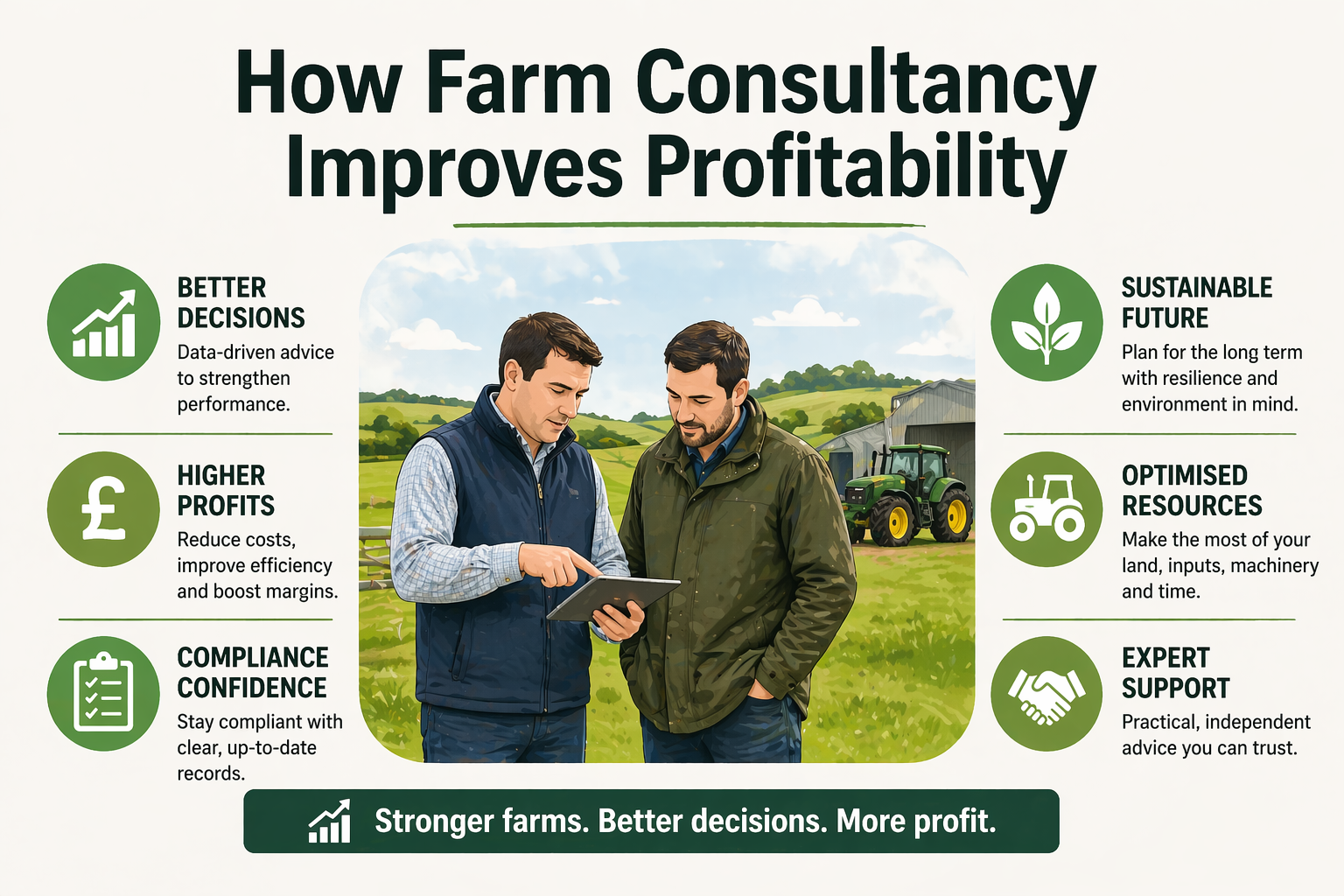
Farm consultancy profitability comes down to one thing: better decisions, made faster, with fewer expensive surprises.
Most farms don’t have a “work ethic” problem. They have a clarity problem. Money leaks out in tiny places, inputs, timing, underperforming enterprises, missed scheme value, messy records, and it adds up.
This is where farm consultancy earns its keep. Not with big words. With practical changes you can actually run on a working farm.
What a farm consultant actually does (in the real world)
At its best, farm consultancy is a mix of:
- Business management (margins, cashflow, benchmarking, decision-making)
- Strategy (where the farm is heading and what to prioritise)
- Compliance & records (risk reduction and payment protection)
- Technical planning (soils, nutrients, systems, performance)
- Funding & schemes (making sure you claim what fits and can evidence it)
Put simply: the goal is farm consultancy profitability through tighter control and clearer choices.
1) Profit starts with knowing your true costs
If you don’t know your cost of production, you’re negotiating and budgeting in the dark.
AHDB is very clear on the value of cost of production and benchmarking, it helps compare performance and identify efficiency gains that improve profit (not just turnover). You can explore AHDB’s cost of production and Farmbench benchmarking tools here:
A consultant will typically help you:
- split enterprises properly (so you can see what’s paying its way)
- identify the biggest cost drivers (feed, fertiliser, machinery, labour, finance)
- set targets that are realistic and measurable
- stop “busy” being mistaken for “profitable”
This is one of the quickest wins for farm consultancy profitability, because once costs are visible, the next steps become obvious.
2) Stop chasing price – build a plan you can stick to
Markets matter. But “I’ll wait for a better price” is not a strategy. It’s a stress hobby.
Profitability improves when the farm has a clear plan for:
- what to produce
- how to produce it efficiently
- what risks to avoid
- what decisions get made early (not late)
If you want a solid read on this mindset (and why it matters), this internal article is ideal:
Don’t chase the price, stick to your strategy
That’s the backbone of farm consultancy profitability: less reactive decision-making, more repeatable decision-making.
3) Schemes and funding: turning admin into income (properly)
Like it or not, schemes are now part of many farm business models. The key is choosing options that actually suit the farm system and workload.
For England, the official starting points include:
A farm consultant can improve profitability by helping you:
- pick actions that work with your rotations, grazing, labour and kit
- avoid agreement choices that create hidden workload
- build evidence and records as you go (so inspections aren’t panic stations)
- stack funding opportunities sensibly (where allowed) without duplicating effort
For South West grant and scheme support, this internal guide is a strong next step:
Farm Grants & Schemes (South West)
This is another big lever for farm consultancy profitability, not “free money”, but better-fit money with fewer mistakes.
4) Transition planning: delinked payments and the “what replaces it?” question
In England, delinked payments replaced BPS. GOV.UK’s guidance explains eligibility and how/when payments are made, including that payments for 2026 and 2027 are planned as single payments from 1 August each year (for eligible customers).
The profitability challenge here is simple: if a chunk of reliable cash changes shape, the business needs a plan.
That plan might include:
- tightening enterprise performance
- reducing avoidable input spend
- using schemes strategically (not randomly)
- reviewing finance and investment timing
For a Devon-focused transition read, you can link internally here:
Future BPS & delinked payments transition (Devon)
This is core farm consultancy profitability: making sure the business model still works as the rules change.
5) Inputs: nutrients and soils are often the fastest margin win
When fertiliser, feed and fuel are expensive, small efficiency gains turn into real money quickly.
Good soil and nutrient planning helps you:
- get better response from every kg applied
- use organic manures more accurately
- avoid over-application that wastes money and increases risk
- prioritise fields that need investment vs fields that don’t
AHDB RB209 is a recognised reference for nutrient management principles and recommendations:
AHDB Nutrient Management Guide (RB209)
If you’re in Somerset, this internal page is relevant:
Soil & Nutrient Management (Somerset)
It’s hard to overstate how often this is the engine of farm consultancy profitability, because it improves output and reduces waste at the same time.
6) Systems and resilience: profitability isn’t just “this year”
Some farms are profitable but fragile. One bad season, one price dip, one staffing issue, and it unravels.
Strong consultancy support looks at resilience too:
- workload and labour reality
- machinery policy (ownership vs contracting, replacement cycles)
- rotation and forage resilience
- soil structure and water management
- long-term system direction
For farms exploring lower-input and resilience approaches, this internal resource is useful:
The point isn’t trends. The point is durable farm consultancy profitability: results that hold up when conditions change.
What this looks like with Siggs & Co (Devon, Somerset, South West)
We’re based in the South West and work with farms across Devon, Somerset and beyond. Our contact page confirms our location in East Knowstone, South Molton (EX36 4DZ), plus telephone and email details.
If you want to explore our consultancy support locally, start here:
- Farming Consultancy Services (Devon)
- Sustainable Farming Scheme in Devon
- Farming: building wealth
- Collaboration in agriculture
When all of this is joined up, costs, strategy, inputs, schemes, records, farm consultancy profitability becomes predictable rather than hopeful.
Contact us
If you want help improving farm consultancy profitability on your business, please get in touch:
Siggs & Co Ltd
East Knowstone, South Molton, EX36 4DZ, United Kingdom
Phone: 01398 392011
Email: contact@siggsandco.com
Contact form: https://www.siggsandco.com/contact/
FAQs
How quickly can farm consultancy improve profitability?
Often within the first season, because the earliest wins usually come from cost control, enterprise focus, and tightening input use. Larger gains (systems, infrastructure, rotations) take longer but can be more durable.
Is consultancy only for large farms?
No. Smaller farms often benefit quickly because clarity on enterprise performance and cashflow removes pressure and improves decision-making.
Do you help with SFI and other schemes?
Yes, and we work from the official guidance so your applications and evidence are aligned with current requirements.
Farm consultancy profitability isn’t about doing more. It’s about doing the right things, with the right numbers, in the right order, and making the farm easier to run.