
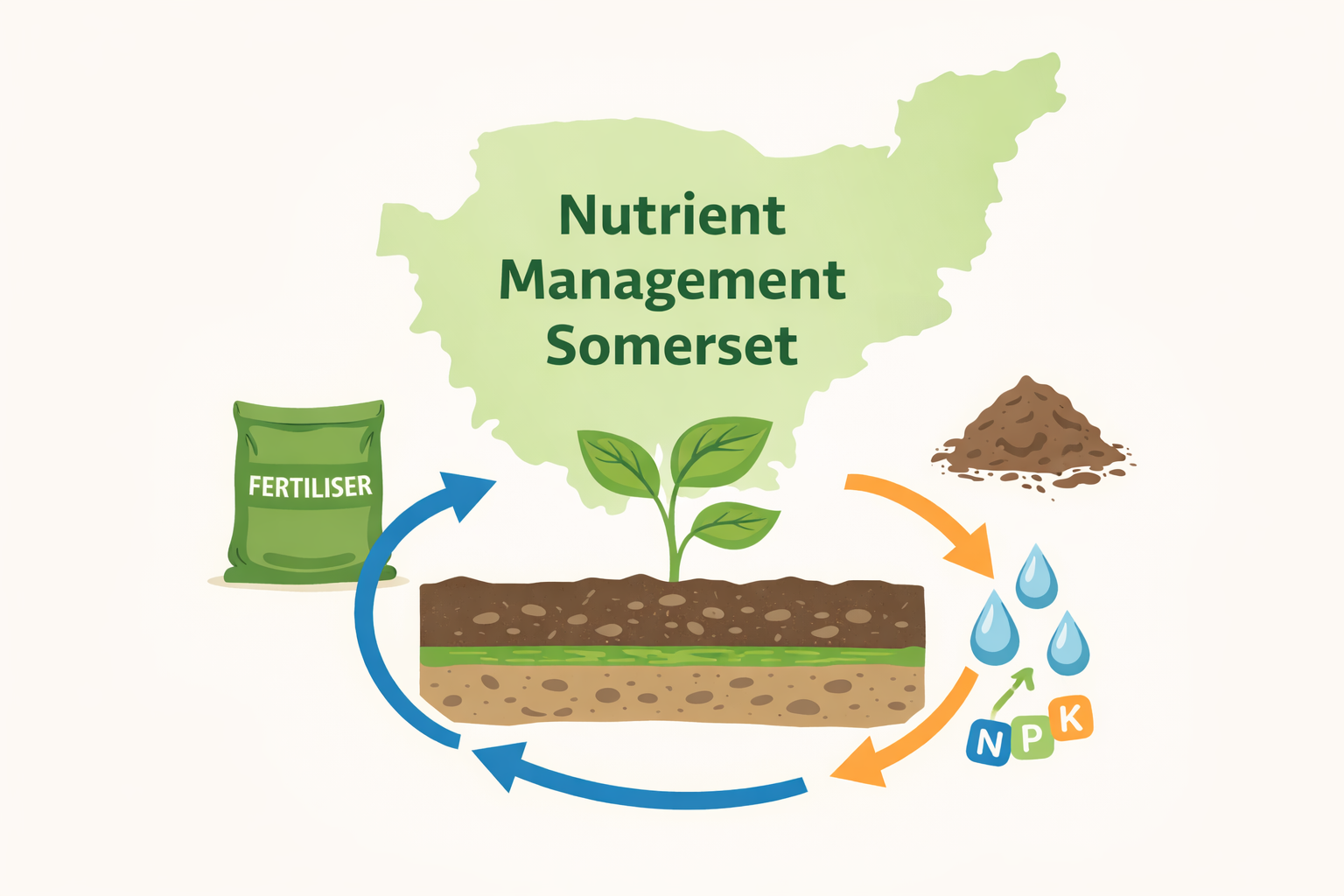
Nutrient Management Somerset is about using the right nutrients, in the right place, at the right time, with evidence to support decisions and a clear focus on profitability.
With fertiliser costs still significant and environmental expectations increasing, nutrient planning is no longer just an agronomy exercise. It is a core business tool that helps control input spend, protects soil function, supports crop performance, and reduces the risk of non-compliance.
This article explains a structured approach to Nutrient Management Somerset, with links to official guidance and recognised references that can support decision-making.
Why nutrient management matters in Somerset
Somerset’s farming systems and landscapes present particular nutrient-management challenges. A strong Nutrient Management Somerset plan recognises these local realities and builds them into decisions:
- Soil and drainage variability across the county can increase run-off and leaching risk if applications are poorly timed.
- Watercourse density is high in many areas, including the Levels and Moors, where connectivity between land and water can be direct.
- Organic manure availability (slurry, FYM, poultry manures, digestate) can be a major resource, but only if nutrient supply is quantified and targeted.
For many businesses, improving nutrient efficiency delivers benefits quickly: reduced purchased fertiliser, better crop response, clearer records, and a stronger position if questioned by regulators or scheme requirements. That is why Nutrient Management Somerset should sit alongside budgeting and operational planning, not behind it.
Key rules and guidance relevant to Somerset
1) Farming Rules for Water
The Farming Rules for Water set out requirements for preventing agricultural diffuse pollution. The official GOV.UK guidance explains expectations relating to fertiliser and manure applications, soil management, and preventing run-off.
GOV.UK also provides supporting information on applying the rules in practice (including storage and spreading considerations).
In practical terms, holdings should be able to demonstrate that nutrient applications are planned and justified based on crop requirement and soil nutrient supply, and that steps are taken to minimise losses to water. A good Nutrient Management Somerset framework makes that evidence straightforward to produce.
2) Nitrate Vulnerable Zones (NVZs) where applicable
If any land is within a Nitrate Vulnerable Zone, additional requirements apply around nitrogen use and organic manure storage and spreading. GOV.UK maintains an NVZ guidance collection.
If NVZ rules apply to your holding, record-keeping and timing requirements become more prescriptive. In those situations, Nutrient Management Somerset should be mapped carefully to NVZ rules, field risk, and available storage capacity.
A structured approach to Nutrient Management Somerset
The most effective nutrient plans are consistent, repeatable and easy to maintain. The approach below is how we typically build Nutrient Management Somerset into a working system for the farm team.
1) Establish a reliable baseline (soil testing and field knowledge)
A nutrient plan is only as good as the data behind it. A robust baseline typically includes:
- Soil pH (to inform liming strategy and nutrient availability)
- P, K and Mg indices
- Soil texture and drainage characteristics by field
- Known risk areas (wet hollows, compacted gateways, slopes, adjacent watercourses)
Where nutrient recommendations are needed, the recognised industry reference is the AHDB Nutrient Management Guide (RB209).
In practice, this baseline is what turns Nutrient Management Somerset from “best guess” into “defensible decisions”. It also helps prioritise spending: correcting pH and soil structure often improves fertiliser response far more than increasing application rates.
2) Quantify nutrient supply from organic manures
Many Somerset farms have access to valuable organic nutrient sources. However, without sampling and realistic nutrient values, holdings often either under-apply (limiting performance) or over-apply (increasing cost and pollution risk).
A practical approach includes:
- Identifying manure types, volumes and likely application windows
- Sampling where appropriate (slurry and digestate in particular)
- Accounting for nutrient availability (not just total nutrient content)
- Prioritising fields where nutrients are needed and risk is lower
This supports better fertiliser decisions and helps demonstrate that applications are planned rather than reactive. In other words, it strengthens Nutrient Management Somerset on both performance and compliance.
3) Match inputs to crop requirement and justify applications
Effective nutrient management aligns supply to crop need and provides a clear rationale for decisions. A workable plan typically records:
- Crop type and realistic yield target (or expected output)
- Soil index and limiting factors (pH, compaction, poor drainage)
- Organic manure supply and timing
- Manufactured fertiliser requirement after accounting for the above
This is consistent with the expectations set out in Farming Rules for Water guidance.
From a business perspective, this is also where Nutrient Management Somerset delivers hard savings: purchased inputs are reduced because the plan properly values what the farm already has available in manures and soil nutrient reserves.
4) Prioritise timing, conditions and risk reduction
In Somerset, timing often determines outcomes. Even accurate application rates can result in losses if ground conditions are unsuitable.
Risk reduction typically includes:
- Avoiding spreading before heavy rain or on saturated, frozen or compacted ground
- Maintaining appropriate buffers and awareness near watercourses
- Targeting lower-risk fields for higher-risk materials
- Improving soil structure where infiltration is limited
Good plans also build in operational reality: trafficability, storage constraints and realistic workloads. This is why Nutrient Management Somerset should be reviewed ahead of key spreading windows, not during them.
5) Keep records simple, consistent and inspection-ready
Records do not need to be complicated, but they do need to be consistent. At a minimum, keep:
- field-by-field application records (product/material, date, rate, operator)
- soil test results and any interpretation used
- manure analyses (where available) and assumptions used
- the decision basis (crop requirement and justification)
A well-managed record set supports compliance and makes year-on-year improvement easier. It also makes Nutrient Management Somerset far more resilient when staff change or contractors are involved.
Additional support: Catchment Sensitive Farming
Catchment Sensitive Farming (CSF) provides advice to farmers in England on reducing diffuse pollution and improving environmental outcomes. GOV.UK provides an overview of CSF support.
You can also contact CSF via the Farming Advice Service.
Used well, this support complements Nutrient Management Somerset by helping identify local risks and improvements that may not be obvious from the office.
How Siggs & Co can help
At Siggs & Co, we support farms with Nutrient Management Somerset through practical planning that reflects the realities of South West farming. This typically includes:
- Soil sampling strategy and interpretation
- Manure and nutrient planning to optimise value from organic resources
- Input planning to reduce unnecessary fertiliser spend
- Record systems that are clear, consistent and inspection-ready
Contact us
If you would like support with Nutrient Management Somerset, whether you need a full nutrient plan, help valuing organic manures, or a review of records and risk areas, please get in touch.
Siggs & Co Ltd
East Knowstone, South Molton, EX36 4DZ, United Kingdom
Phone: 01398 392011
Email: hello@siggsandco.com
Contact form: https://www.siggsandco.com/contact/
FAQs
Do I need a nutrient plan to comply with Farming Rules for Water?
You should be able to demonstrate that nutrient applications are justified by crop and soil need, and that steps are taken to reduce losses to water. GOV.UK guidance explains the expectations.
What is the recognised reference for nutrient recommendations?
AHDB’s Nutrient Management Guide (RB209) is widely used for nutrient planning and recommendations across systems.
What if part of my holding is in an NVZ?
If NVZ rules apply, additional requirements apply to nitrogen use and manure storage/spreading, and record-keeping expectations increase. GOV.UK maintains NVZ guidance here.