
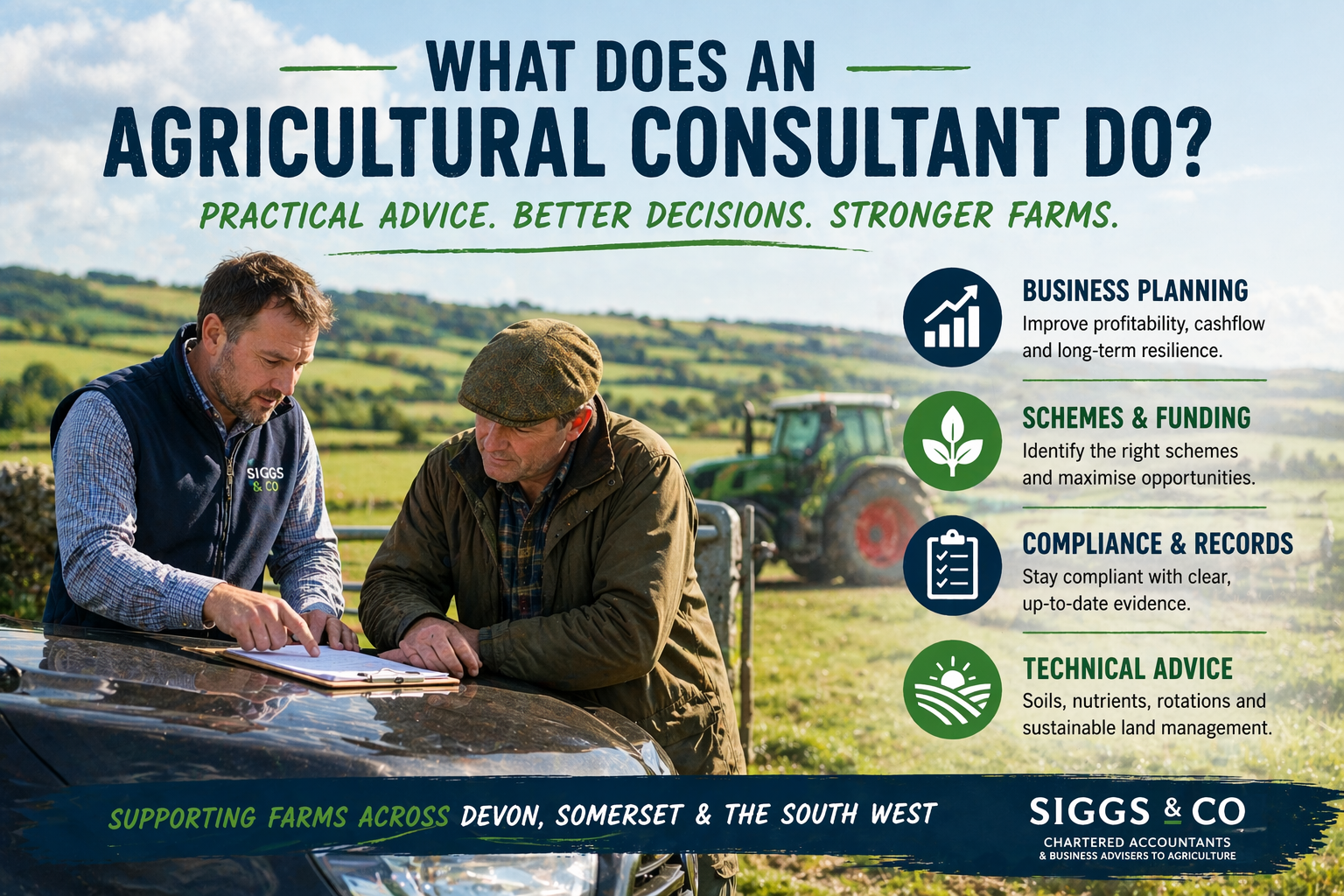
An agricultural consultant helps you make better decisions on the farm, the kind that protect profit, reduce risk, and stop “we’ll deal with it later” turning into an expensive surprise.
I run Siggs & Co, and when people ask, “What does an agricultural consultant do?” they usually mean one of two things:
- “Will you help me make more money (or lose less)?”
- “Will you help me stay on the right side of rules, schemes and inspections?”
The honest answer is: yes, but not by dumping a 60-page report on your desk and vanishing into the mist. A good agricultural consultant works with you to create a plan you can actually run with, week to week, season to season.
In plain English: the job is “clarity”
Farming is full of moving parts: weather, markets, labour, input costs, policy changes, and timing. A good agricultural consultant brings clarity when things get noisy.
That clarity normally falls into four areas:
- Business performance (profit, cashflow, enterprise margins)
- Schemes and funding (SFI, Countryside Stewardship, grants)
- Compliance and evidence (records, mapping, inspection readiness)
- Technical planning (soil, nutrients, system changes, environmental outcomes)
If you want a local example of how we deliver this kind of support, our Devon page is here: Farming consultancy services in Devon.
1) Business planning: turning “busy” into “profitable”
Most farms are busy. That doesn’t always mean they’re profitable.
A strong agricultural consultant helps you answer questions like:
- Which enterprises make money (and which ones soak it up)?
- What does the next 12–36 months look like for cashflow?
- What happens if prices drop, yields dip, or costs rise?
- Is this investment (kit, buildings, land) truly affordable?
It’s not about being pessimistic. It’s about being prepared. If you’ve ever watched a good sheepdog work, you’ll get the idea: calm pressure, clear direction, no drama. That’s the aim.
We also lean on practical strategy thinking, because chasing price alone is a fast route to frustration. This article explains the mindset well: Don’t chase the price, stick to your strategy.
2) Schemes and funding: helping you claim what fits (and avoid what doesn’t)
In England, a lot of scheme administration runs through the Rural Payments Agency (RPA).
Many farmers ask an agricultural consultant to help with:
- SFI applications and agreement management (actions, evidence, timings)
- Countryside Stewardship (options, mapping, capital items, upgrades)
- Grant opportunities (what’s open, what’s realistic, what’s worth the time)
Here are the official starting points (worth bookmarking):
- Sustainable Farming Incentive guidance: GOV.UK SFI guidance collection.
- Countryside Stewardship guidance: GOV.UK Countryside Stewardship guidance collection.
On our side, we keep scheme support practical and joined-up with the wider business plan. If you want examples of the kind of grants and schemes we support across the South West, start here: Farm grants & schemes in the South West.
Bottom line: a good agricultural consultant doesn’t just help you “get into a scheme”. They help you choose the right scheme, at the right scale, with the right workload, so it actually works on your farm.
3) Compliance and inspections: evidence, not panic
Compliance is rarely about trying to do the wrong thing. It’s usually about:
- records not being consistent
- maps not matching reality
- evidence not being easy to find
- deadlines sneaking up
An agricultural consultant helps you build a simple system: keep the right records, in the right format, ready when needed. That might include field operations logs, nutrient plans, scheme evidence, livestock movement paperwork (where relevant), contractor notes, and a clear “what we did and why” trail.
It’s also about future-proofing. Policies and schemes move. Record standards can tighten. The farms that cope best are the ones with tidy processes already in place.
4) Technical planning: soils, nutrients, and whole-farm improvements
This is where a lot of money is won or lost.
A strong agricultural consultant will often support:
- soil testing strategy and interpretation
- nutrient and manure planning (cutting waste, improving response)
- crop rotations and forage planning
- environmental measures that also support the system
For nutrient recommendations and principles, RB209 is a recognised UK reference: AHDB Nutrient Management Guide (RB209).
If you’re in Somerset and want to see how we approach this locally, this page is a good overview: Soil & nutrient management in Somerset.
And if you’re moving towards system change, we also work with farms exploring lower-input approaches and resilience planning, including: Regenerative agriculture.
Done well, this side of the work makes the farm more efficient, less exposed to volatility, and better able to keep margins when costs rise.
So… when should you bring in an agricultural consultant?
You don’t need an agricultural consultant to tell you how to farm. You need one when you want better outcomes with fewer headaches.
Common triggers we see:
- you want to improve profit but aren’t sure where the biggest levers are
- you’re applying for schemes and want to avoid costly mistakes
- you’re considering investment and need the numbers checked properly
- compliance feels messy (and you want it calm and predictable)
- you want a plan that ties together soils, inputs, systems and finance
In short: an agricultural consultant helps you make fewer “gut-feel” decisions, and more “measured” decisions — without slowing the farm down.
Work with Siggs & Co
If you want an agricultural consultant who keeps things practical, clear and farm-focused, you can explore our work here:
- Farming consultancy services (Devon)
- Farm grants & schemes support
- Soil & nutrient planning (Somerset)
Contact us
If you’d like to talk through your farm, your plans, or your next application, please get in touch.
Siggs & Co Ltd
East Knowstone, South Molton, EX36 4DZ, United Kingdom
Phone: 01398 392011
Email: hello@siggsandco.com
Contact form: https://www.siggsandco.com/contact/
FAQs
Is an agricultural consultant the same as an agronomist?
Sometimes the roles overlap, but they’re not always the same. An agricultural consultant often covers whole-farm planning: business performance, schemes, compliance, and technical decisions. An agronomist is typically more crop-input focused.
Can an agricultural consultant help with SFI or Countryside Stewardship?
Yes. Many farms use an agricultural consultant to choose the right options, build workable evidence, and keep agreements running smoothly. Official guidance is on GOV.UK.
Do you work only in Devon and Somerset?
Devon and Somerset are core areas for Siggs & Co, but we support farms across the South West and beyond where it makes sense.
An agricultural consultant is there to strengthen decisions, reduce risk, and help your farm run with more control, not more complexity.